
A year on Vercel and one evening of moving: bazariara.ge has become faster and is opening again in Russia
Bazari Ara is an online store of Georgian products, gifts and travel equipment in Tbilisi. Next.js 16, PostgreSQL, images in object storage. The project is about a year old, and all this year it lived on Vercel with its database in Neon.
We moved it to RelaxDev and did not expect such a result:
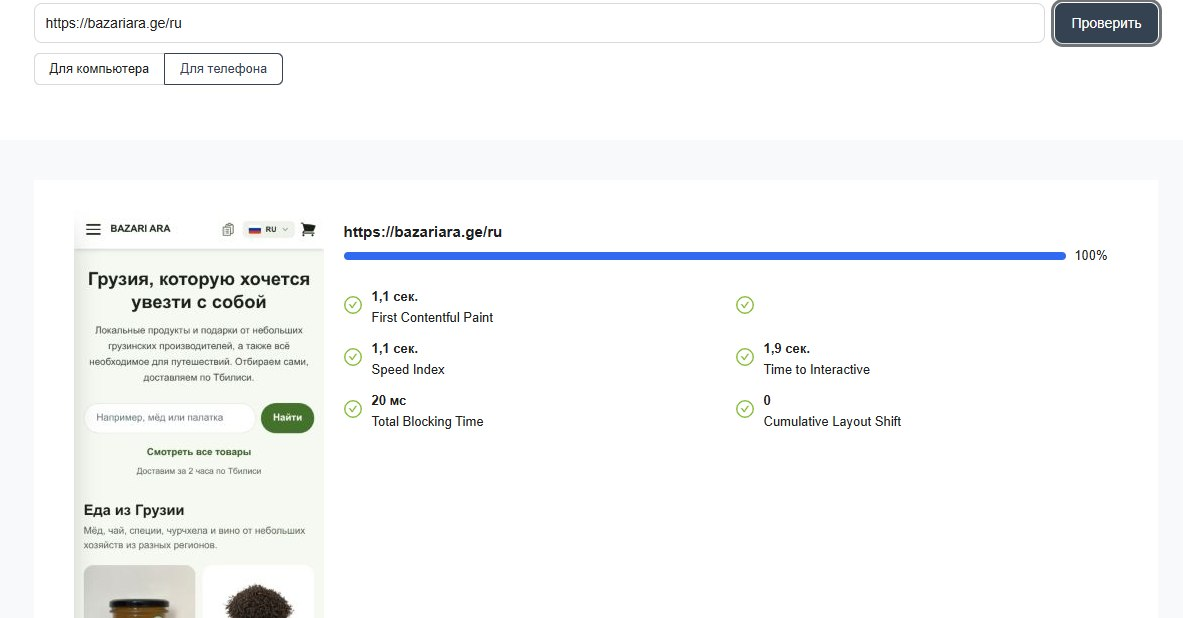
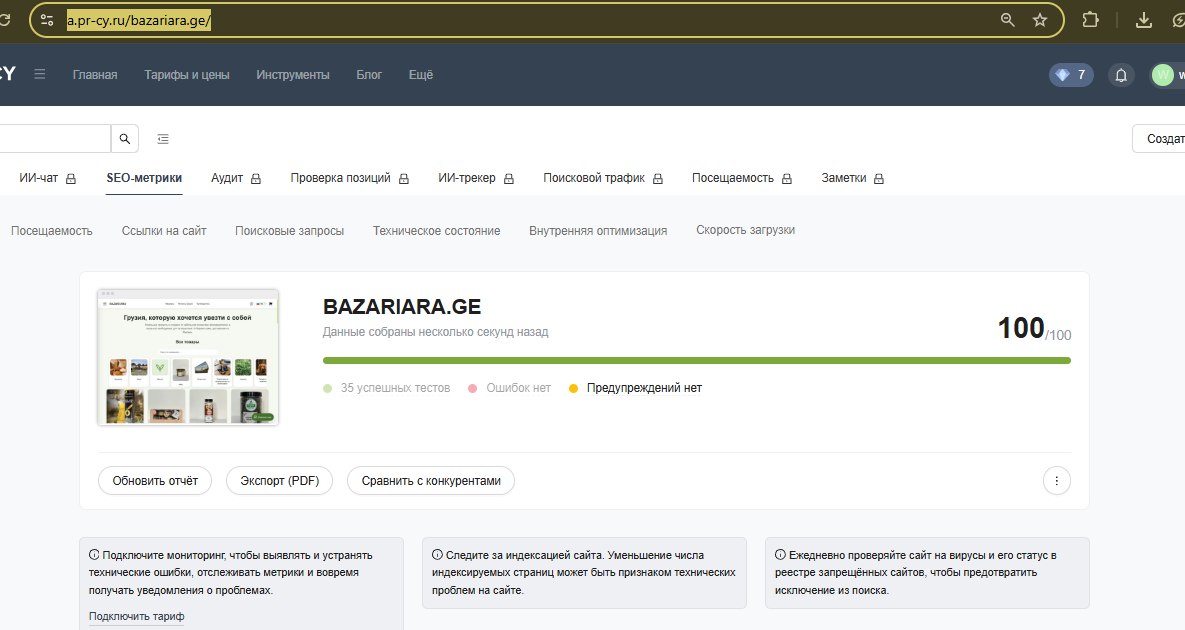
- ✅ 100 out of 100 on three checks: PageSpeed Insights, plus speed and site analysis in PR-CY;
- ⚡ from Tbilisi the server responds in 0.12–0.14 s instead of 1.5–3.5 s;
- 🇷🇺 the site opens from Russia again, from Moscow the response takes 0.02–0.03 s;
- 🪶 the page is 7 times lighter, the home page HTML three times lighter, a catalog image 10 times lighter.
Update, November 6, 2026. Visitors from Georgia now get the site from a caching server in Tbilisi; the app and the database stay on RelaxDev. PageSpeed on mobile is still 100, LCP 1.0 s, Speed Index 1.7 s. How it works: “bazariara.ge is now served from Tbilisi”.
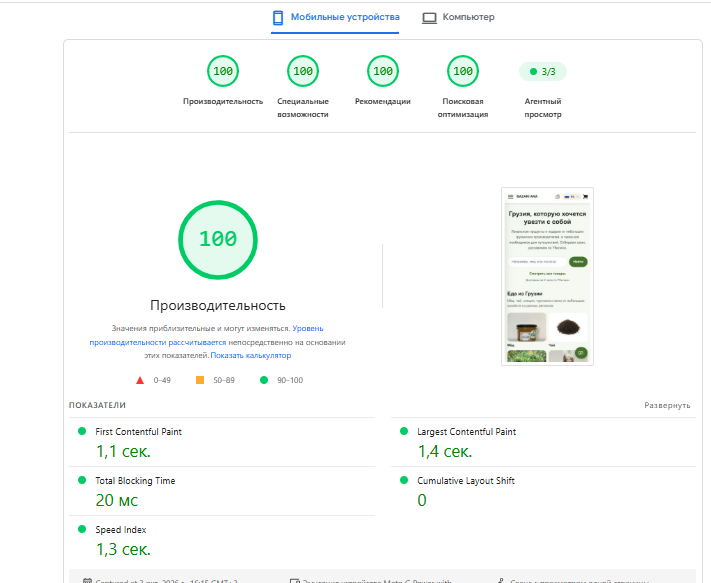 Result: 100 out of 100
Why we left Vercel
| Problem | What it meant for the store |
|---|---|
| 🚫 Site unavailable in Russia | The store did not open on regular ISPs and mobile networks. The main reason for moving |
| 🗄 Database limits | Neon's free plan kept hitting limits, and we didn't want to pay for the database separately from hosting |
| 🧊 Aggressive cache | Vercel kept serving old product cards for a long time: the price or stock had changed, but visitors saw the old ones |
| 🖼 Image optimization quota | Image optimization had to be turned off so the quota wouldn't burn out. The catalog served originals of 100–450 KB |
| 🐢 Cold start | The first visitor after a pause waited 1.5–3.5 seconds for the server to respond |
Where to move: Russia, Türkiye or Poland
Almost all customers are in Georgia, some are in Russia. Before moving, we measured every option: pings between servers, requests from servers, and Globalping — three probes in Tbilisi (Magticom, TradeZone, Cloud 9) and three in Moscow and Saint Petersburg (Yandex.Cloud, Timeweb, Selectel).
Candidates:
- Vercel — where the site lived;
- Russia — RelaxDev, our server in Moscow;
- Türkiye — a test server: we could move the app there or route visitors through it;
- Poland — the RelaxDev European node, which can also take visitors.
Pings between servers
| From → to | Ping, average | Range |
|---|---|---|
| Moscow → Türkiye | 83 ms | 78–87 ms |
| Türkiye → Moscow | 79 ms | 78–80 ms |
| Moscow → Vercel | 65 ms | 46–133 ms |
| Türkiye → Vercel | 10 ms | 9–11 ms |
Requests to the site from servers
Three requests in a row. Here we measured the redirect response from / to /ru, so this is server time, not the whole page.
| From → to | Connect | First byte |
|---|---|---|
| Moscow → Vercel | 48–199 ms | 0.24–0.88 s |
| Türkiye → Vercel | 43–69 ms | 0.20–0.40 s |
| Türkiye → RelaxDev in Russia | 0.25–5.16 s | 0.84–5.36 s |
The last row is the main discovery. The Türkiye → Russia link is unstable on new connections: connecting sometimes takes five seconds.
How close each location is to customers
Globalping, connection time (TCP) — pure network, no server work.
| Location | from Tbilisi | from Moscow and St. Petersburg |
|---|---|---|
| Vercel (point of presence right in Tbilisi) | 2–39 ms | 6–87 ms |
| Türkiye | 30–99 ms | 77–95 ms |
| Poland | 71–82 ms | 42–72 ms |
| Russia, RelaxDev directly | 85–121 ms | 0–12 ms |
On the network, Vercel and Türkiye are closest to Georgia. But the network is only part of the answer.
How long until the first byte of the page
| Route | from Tbilisi | from Moscow and St. Petersburg |
|---|---|---|
| Vercel | 1.56–3.54 s | 0.46–0.67 s |
| Via a server in Türkiye | 0.29–0.56 s | 0.66–1.14 s |
| Via the node in Poland ¹ | 0.15–0.16 s | 0.12–0.14 s |
| Russia, RelaxDev directly | 0.12–0.14 s | 0.02–0.03 s |
For comparison: a static page served by nginx directly from the Turkish server takes 0.04–0.09 s from Tbilisi. A server in Türkiye is good, but only if everything lives on it at once.
¹ Measured on another platform project that already runs through the Polish node. The direct route to Russia was measured there too: 0.10–0.13 s from Tbilisi — the same numbers as bazariara.
The database must sit next to the app
We learned this first-hand. While the app was already running in Russia, the database was still in Neon (Frankfurt):
| Measurement | Result |
|---|---|
| Connecting to Neon from Russia | 0.8 s just to establish a connection |
| Page from Tbilisi, cold cache | 8.5–9.6 s |
| The same page from Moscow, cache already warm | 0.13 s |
pg_dump from Neon directly to Russia | hung, stopped manually |
pg_dump via the server in Poland | 12.6 s |
Every page request to a database abroad paid for the trip there and back, so move the database first and only then measure speed.
Why not Türkiye
- On mobile internet in Russia, the site on the Turkish server did not open. Russian mobile operators handle connections to foreign hosting poorly. We would have had to split visitors by country with GeoDNS.
- An intermediate server in Türkiye only adds distance: from Tbilisi the first byte took 0.29–0.56 s versus 0.12–0.14 directly, from Moscow up to a second.
- The Türkiye → Russia link is unstable: connecting takes from 0.25 to 5.2 seconds.
- If the app itself lives in Türkiye, the database moves there too. That means a second site and a second database.
- The network gain for Georgia is 30–60 ms. Not worth a second site, a second database and GeoDNS.
Why not Poland
The Polish node is an extra hop on the way. For Georgia it is slower than going direct: the TLS handshake goes through Poland, 219–241 ms versus 106–136 directly. It adds delay for visitors from Russia too.
Conclusion: the simplest and fastest option is directly to Russia, on RelaxDev. Georgia gets the first byte in 0.12–0.14 s, Russia in 0.02–0.03 s, with one site and one database.
How we moved
1. Environment variables — one command
npx vercel link
npx vercel env pull .env.vercel --environment=production
The whole file is imported in the “Variables” tab. Quotes are stripped automatically, and the service variables VERCEL_* and TURBO_* are skipped.
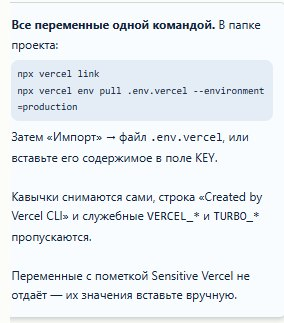 Importing variables from Vercel in the “Variables” tab Importing variables from the
.env.vercel file
2. Database — import by connection string
The “Database” tab can import from another database: we pasted the Neon connection string, and the data moved into the platform database. The platform added the connection string for the new database to the project variables by itself.
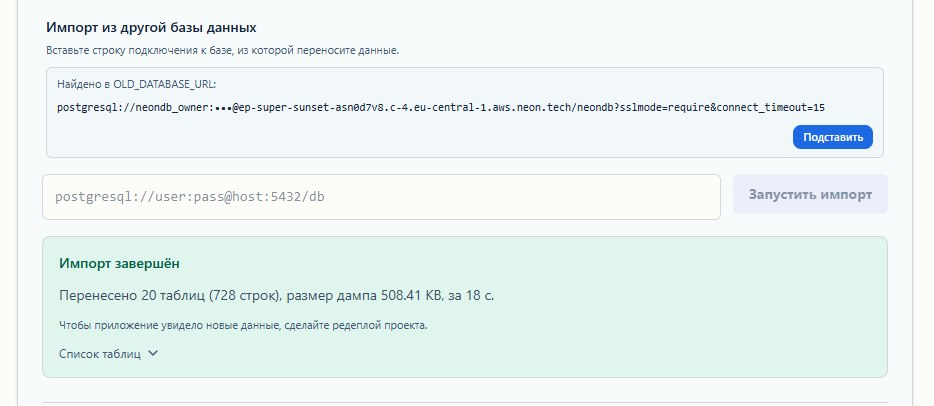 Importing the database from Neon by connection string Importing the database from Neon by connection string
3. Code — changes for a long-running server
On Vercel every function lives on its own; on RelaxDev the app runs as one long-lived process.
| Was (for Vercel) | Now | Why |
|---|---|---|
ssl: 'require' always | SSL from the connection string | Neon requires SSL, the platform database runs inside the network without it |
max: 1 — one connection | default pool (up to 10) | Page queries via Promise.all run concurrently instead of one by one |
prepare: false | default | Only needed for the Neon pooler |
4. DNS — via Cloudflare
The .ge registrar's zone still had a hidden Vercel record (216.198.79.1, TTL 3600) that wasn't visible in the panel: DNS returned both addresses, and some visitors landed on the old site. We fixed it by moving the A records to Cloudflare. The records are “DNS only”: Cloudflare only answers which address the domain has, and traffic goes straight to the server.
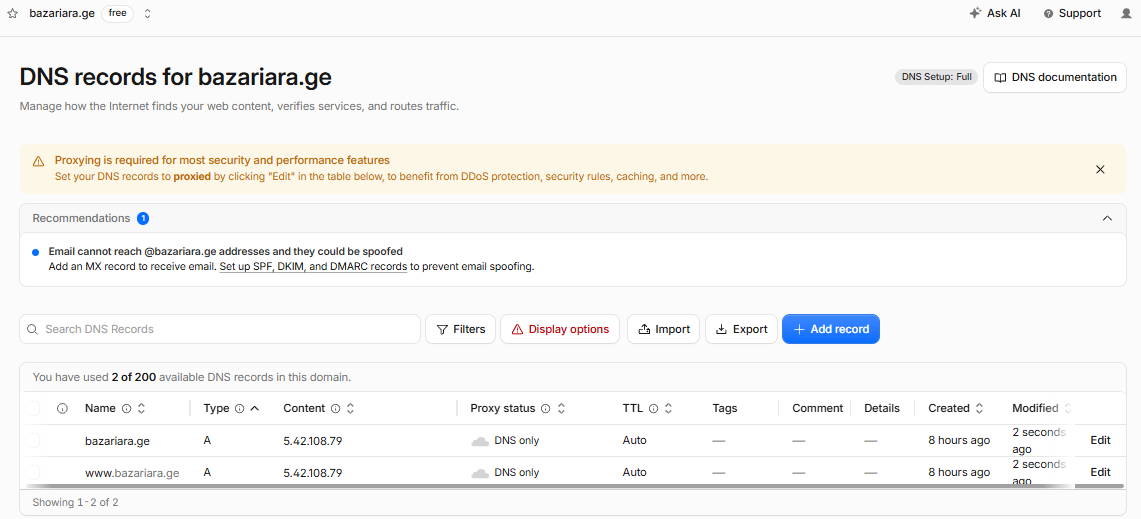 A records in Cloudflare in DNS only mode A records in Cloudflare, “DNS only” mode
What we sped up after the move
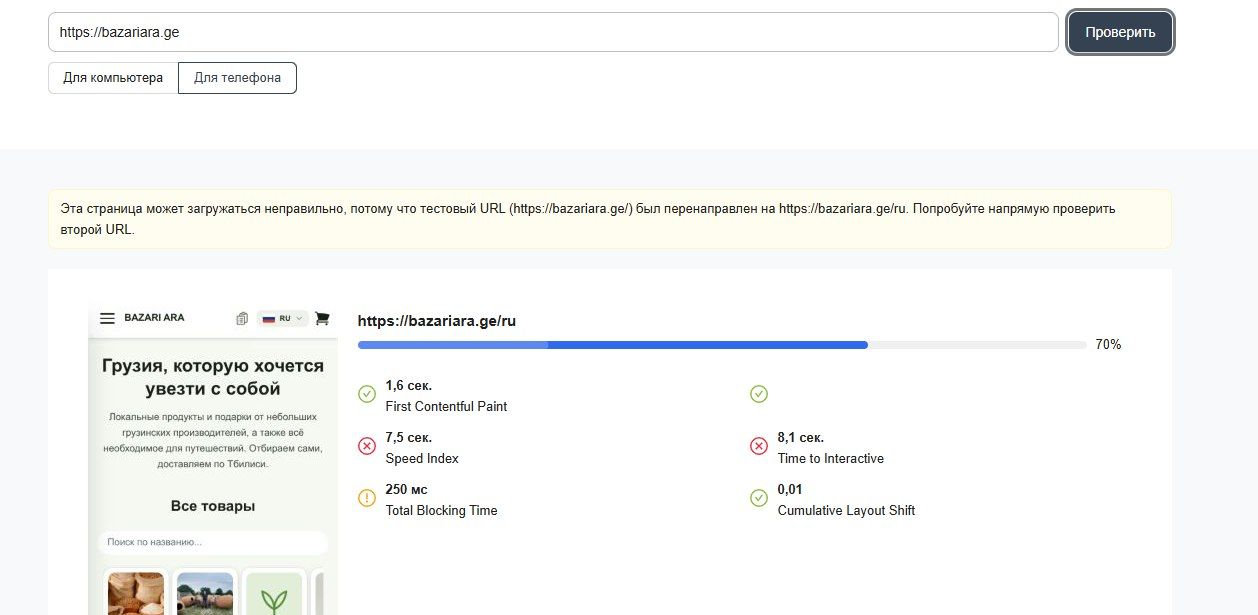
Right after the move the PR-CY score even dropped, from 87 to 79. The server responded faster, but in the browser the page was still heavy: 5.5 MB, of which 4.7 MB were images. Next came work on the page itself.
| What | Before | After |
|---|---|---|
| 🖼 Catalog images | originals of 100–450 KB: optimization off because of the Vercel quota | WebP 256–640 px wide via the Next.js optimizer — free on your own server |
| 🎞 Card slider | the browser loaded all photos at once: 20 cards — about 33 images | the second and further photos load only when the person reaches for the gallery |
| 📦 Product card data in HTML | ~6 KB per product: three full descriptions and service fields | ~1.2 KB: only what the card shows |
| 🏠 Home page | the whole catalog: 20 cards, 4 photos at once, one of them 436 KB | first screen is text and search, sections with lazy photos below |
| ✂️ Home page JS | loaded the catalog code — slider, cards, filters (~100 KB) | the catalog is a separate route, category URLs unchanged |
| 🎨 CSS | two files blocked the first paint (460 ms) | one 8.6 KB file: 170 ms on the first visit only, then from cache on every page |
| 💬 Support chat | in the required JS of every page | loaded after the first paint |
| 📊 Google and Yandex Metrica counters (~280 KB JS) | loaded together with the page | on the visitor's first interaction or after 5 seconds; never loaded for bots |
| ♻️ Page cache | lost on every cold start of the functions | lives in the process until the next deploy, refreshed in the background |
To be honest about the counters: someone who closes the page within 5 seconds without touching it won't show up in the stats. We're fine with that.
Numbers
Service scores
| Check | Vercel | RelaxDev |
|---|---|---|
| PageSpeed Insights, mobile | not measured | 100 |
| PR-CY, loading speed | 87 | 100 |
| PR-CY, site analysis | not measured | 100 |
Result: 100 out of 100 PageSpeed Insights, mobile — after the move
 PR-CY, speed — before optimization PR-CY, loading speed — before optimization
 PR-CY, speed — 100 PR-CY, loading speed — after optimization
 PR-CY, site analysis — 100 PR-CY, site analysis
PageSpeed Insights by category
Lighthouse 13.5, mobile profile: Moto G Power, slow 4G.
| Category | Now |
|---|---|
| Performance | 100 |
| Accessibility | 100 |
| Best practices | 100 |
| SEO | 100 |
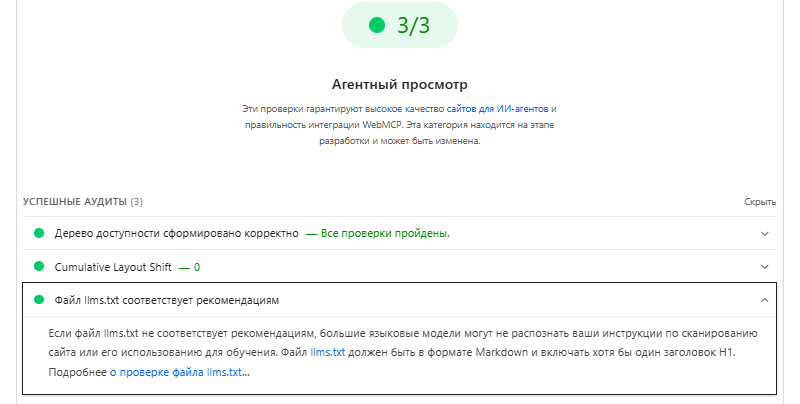
| Agentic browsing | 3/3 |
“Agentic browsing” is a new Lighthouse category: how convenient the site is for AI agents. It checks the accessibility tree, layout stability, the llms.txt file and WebMCP markup.
 PageSpeed Insights — agentic browsing 3/3 PageSpeed Insights: “Agentic browsing” — 3 out of 3
/ru page load metrics in PR-CY before optimization
| Metric | Vercel | RelaxDev, right after the move |
|---|---|---|
| Score | 87 | 79 |
| First Contentful Paint | 1.1 s | 1.8 s |
| Speed Index | 4.9 s | 2.7 s |
| Time to Interactive | 8.4 s | 8.5 s |
| Total Blocking Time | 150 ms | 240 ms |
| Cumulative Layout Shift | 0 | 0.01 |
| Largest Contentful Paint | — | 4.4 s |
| Server response (TTFB) | — | 110 ms |
After optimization PR-CY gives 100 — see the screenshot above. The right column shows it honestly: the move by itself didn't make the browser side faster. The main speed-up came from images, a lighter home page and deferred counters. But on Vercel this ran into the image quota and the way the platform works.
Page weight
| After the move, before optimization | Now | |
|---|---|---|
| Whole page with all files ² | 5,478 KB, 84 requests | 723 KB, 58 requests |
| Images on the page ² | 4,735 KB, 43 | 179 KB, 20 |
| Home page HTML | 354 KB | 110 KB |
| React data inside HTML | 260 KB | 57 KB |
| Styles | 2 files, blocked rendering for 460 ms | 1 file, 8.6 KB, then from cache |
| Product image, example | 436 KB (original) | 44 KB ³ |
² PR-CY, measured before the counters were deferred: now about 280 KB of Google and Metrica scripts out of these 723 KB aren't downloaded on first load.
³ JPEG size when requested without webp support. Browsers get webp, which is even lighter.
Styles: inside the HTML or as a file
Next can inline CSS right into the page (experimental.inlineCss). We did that at first: the separate request for styles before the first paint disappeared, and Lighthouse gave 100. Then we took the HTML apart and saw that Next writes the styles three times: 40 KB in the <style> tag and twice more, 40 KB each, in the React data. Of the 232 KB of home page HTML, 121 KB were styles — in every page opened.
We went back to a separate stylesheet. The home page HTML became 110 KB instead of 232, React data 57 KB instead of 139. The stylesheet weighs 8.6 KB, is downloaded once per visit and then comes from cache on every page. That pays off for visitors who view several pages and for search bots that crawl all 928 URLs.
The price: on the very first visit the browser waits for the stylesheet — 170 ms on slow 4G. Because of that, the lab Speed Index went up from 1.3 to 2.4 s. First paint and LCP didn't get worse, and 2.4 s is still in the “green” zone.
Both measurements are PageSpeed Insights, mobile:
| Metric | Styles inside HTML | Styles as a separate file |
|---|---|---|
| First Contentful Paint | 1.1 s | 1.0 s |
| Largest Contentful Paint | 1.4 s | 1.3 s |
| Total Blocking Time | 20 ms | 30 ms |
| Cumulative Layout Shift | 0 | 0 |
| Speed Index | 1.3 s | 2.4 s |
Update, November: styles are still a separate file, and with the caching server in Tbilisi LCP is 1.0 s and Speed Index is 1.7 s.
Server response by stage of the move
Globalping, the /ru page, three probes in each country.
| Stage | Tbilisi: first byte | Tbilisi: full response ⁴ | Moscow and St. Petersburg: first byte | Moscow and St. Petersburg: full response ⁴ |
|---|---|---|---|---|
| Vercel + Neon | 1.56–3.54 s | 3.5–3.6 s | 0.46–0.67 s | 0.60–0.94 s |
| RelaxDev, database still in Neon | 8.5–9.6 s | 9.0–10.8 s | 0.12–0.13 s | 0.19–0.23 s |
| RelaxDev + own database | 0.16–0.17 s | 0.36–0.39 s | 0.05 s | 0.11–0.13 s |
| RelaxDev after optimization | 0.12–0.14 s | 0.42 s | 0.02–0.03 s | 0.12–0.20 s |
⁴ The full response includes the DNS lookup. In the last measurement the domain had just moved to Cloudflare and was resolved from scratch (40–150 ms); in the previous one the address was cached (1–30 ms).
The Vercel numbers include the function cold start. But that is exactly what a real visitor sees after a pause. Probes in Moscow data centers did reach Vercel, while on regular ISPs and mobile networks the site didn't open.
SEO and AI agents
Since we were working on speed anyway, we went over the technical side too.
| Before | Now | |
|---|---|---|
URLs in sitemap.xml | 30 | 928 |
| Home and category URLs in the sitemap | with a trailing slash, each one a redirect | match the canonical |
lang on English and Georgian pages | ru | en, ka |
| Outdoor subcategory pages | 0 | 8: tents, grills, firewood, thermoses… |
llms.txt for AI assistants | last year's range, links to deleted sections | built from the database |
| Name on the cart icon | none — a “link without a name” for screen readers and agents | present |
| Search form | plain | WebMCP markup: browser agents see it as a “product search” tool |
Subcategories are a story of their own. For “tents”, “firewood” and “grills” the store already ranked 3rd–4th, but there were no pages for those queries: products had no subcategory set. We set them from the product names, and eight new pages appeared, linked from the home page.
What came up after the move
The move took one evening. The following days went into what came up afterwards — maybe this part is more useful than the numbers.
A sitemap with 30 URLs. Next built the sitemap once, at build time, and there was no database during the build. Database errors were swallowed silently, and only static pages stayed in the sitemap — until the next build. Now it is built on every request.
Stubs instead of environment variables. At build time the platform substitutes stubs like auto-generated-stub-for-build for variables that aren't set, and they survive into runtime. Next bakes everything starting with NEXT_PUBLIC_ into the code at build time, so a forgotten public variable reaches the browser as a stub. Now stubs are cleared when the server starts, and their list goes to the log: you can see right away which variables weren't moved from Vercel.
Telegram notifications didn't work the first time. After the move the bot stopped sending orders and replying in the support chat. We fixed it in the panel: enabled the webhook receiver and the network settings for outgoing requests. One subtlety: the receiver sets the webhook with a secret from the project variables, and the site must check exactly that secret — at first we got 401 errors.
A phone mask that was losing customers. Not about speed, but it came up in the same days. The phone field cut pasted numbers to length and didn't strip the country code: “+7 989 156-35-49” became “+7 798915635”, and the order didn't go through. Now a number can be pasted any way — with +7, with 8, with brackets — and the country is detected from the code.
An old prisma db push --accept-data-loss line in the relaxdev.ru builder. Prisma hadn't been used in the code for a long time, but the line stayed. While the build had no database access, it failed silently. Had we given it access, it would have brought the database in line with a schema that has no blog or support chat tables.
Summary
- ✅ The site opens from Russia again.
- ✅ 100 out of 100 in PageSpeed Insights and in PR-CY speed and site analysis.
- ✅ In Georgia the server responds in 0.12–0.14 s instead of 1.5–3.5, the whole page arrives in 0.42 s instead of 3.5.
- ✅ The page is 7 times lighter: 723 KB instead of 5.5 MB, home page HTML 110 KB instead of 354, catalog images 10 times lighter.
- ✅ No database limits and no stale product cards.
- ✅ The sitemap has 928 URLs instead of 30.
- ✅ The whole move took one evening: variables in one command, the database by connection string, a couple of code changes.
- ✅ No more counting Vercel resource limits, and we're confident the site will be up over the holidays.
Measurement links:
- PageSpeed Insights: pagespeed.web.dev/analysis/https-bazariara-ge-ru/xe3ssq4poa?form_factor=mobile
- PR-CY, speed: pr-cy.ru/speed_test/?device=mobile&url=https%3A%2F%2Fbazariara.ge%2Fru
- PR-CY, site analysis: a.pr-cy.ru/bazariara.ge/
We're also on VC, with an SEO angle and without the technical details: vc.ru/seo/3174406-perenos-sayta-dlya-gruzii-na-relaxdev
This is a translation of the original Russian article. Comments are on the Russian page.